
Why MSME classification matters for growing businesses
If you run a small business in India, “MSME classification” is more than a label. It is how many lenders, procurement portals, and government systems recognise your enterprise category, typically as Micro, Small, or Medium. That category affects what benefits you may be eligible for and how your business is treated in formal processes like banking and public procurement.
The scale is also enormous. Official MSME dashboard shows that as on date, total formalised registrations (including Udyam and the Udyam Assist Platform) are in the crores, with “Micro” being the vast majority.
Why should you care, practically?
First, categorisation is tied to a standardised certificate. The Udyam system issues an online certificate with a verifiable QR code, and it does not require renewal in the usual sense.
Second, classification has real financing consequences. The RBI’s consumer FAQ notes that banks are guided by the classification recorded in the Udyam Registration Certificate for priority sector lending categorisation.
Third, MSMEs are a policy focus. Recent official releases highlight large-scale adoption of Udyam and mention ongoing measures to improve institutional credit access and competitiveness for registered MSMEs.
Within Archbridge Capital’s core philosophy, this aligns closely with building “simple, transparent, customer-first” financial journeys. It is easier to build trust and speed in credit discussions when your business identity is clearly formalised and verifiable.
Updated MSME classification criteria and how to calculate it
The latest MSME classification limit
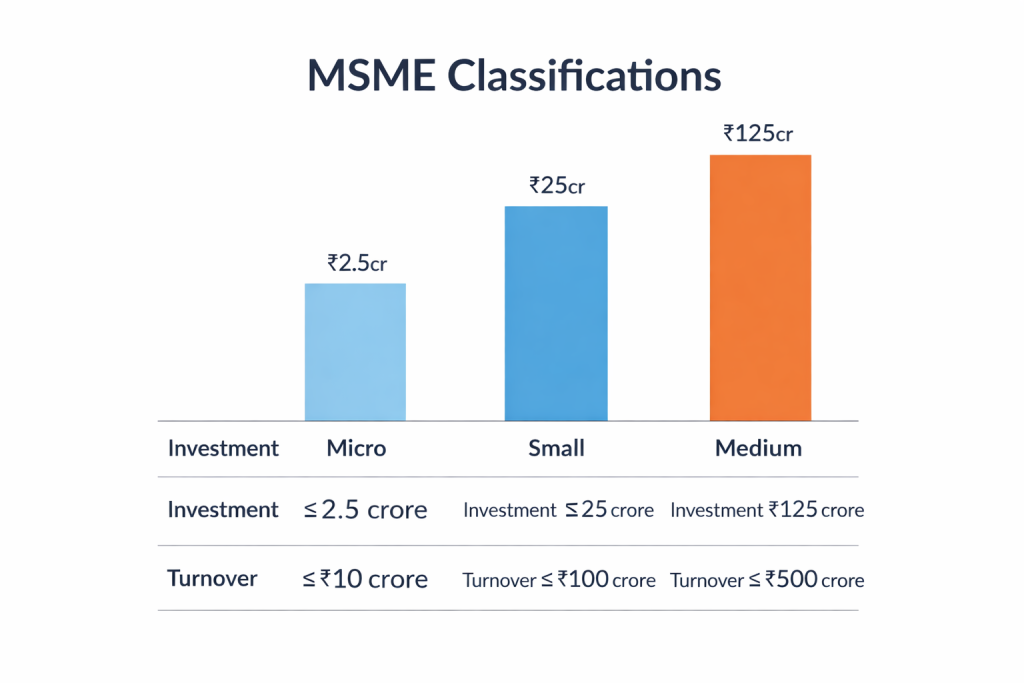
The revised MSME classification limits (investment and turnover) were notified with effect from April 2025, and the Udyam portal itself lists the post-change thresholds.
Here is the core classification table used in practice:
| Enterprise Category | Investment in Plant & Machinery/Equipment | Annual Turnover |
| Micro | Up to ₹2.5 crore | Up to ₹10 crore |
| Small | Up to ₹25 crore | Up to ₹100 crore |
| Medium | Up to ₹125 crore | Up to ₹500 crore |
What “composite criteria” really means
MSME Classification uses a composite criterion: investment plus turnover. If an enterprise crosses the ceiling limit for its current category in either investment or turnover, it moves to the next higher category. It is not placed in a lower category unless it goes below the ceiling limits in both investment and turnover.
This single rule explains many “surprises” business owners face. For example, a fast-growing services firm may have relatively modest equipment investment but may move categories because turnover rises quickly.
How investment is calculated
“Investment in plant and machinery or equipment” is not meant to include everything you own.
Key points from the legal framework include:
- Investment calculation is linked to the Income Tax Return (ITR) of prior years. For a brand-new enterprise with no prior ITR, it starts on self-declaration, but that relaxation ends after the financial year in which the enterprise files its first ITR.
- “Plant and machinery or equipment” includes tangible assets but excludes land and buildings, as well as furniture and fittings.
- Invoice value is considered excluding GST for self-disclosure cases.
- The Udyam process uses “Written Down Value (WDV)” style treatment in the online form context, aligning with depreciation concepts under income tax, rather than the historical approach of original purchase price.
If the term “Written Down Value (WDV)” is new, it is essentially the depreciated value of an asset after accounting for depreciation over time, rather than the day-one purchase amount.
How turnover is calculated
Turnover and export turnover are linked to income tax and GST systems in the Udyam framework. Also, exports of goods or services are excluded while calculating turnover for MSME classification.
In plain language: if you sell in India and export, the export portion is generally not counted for the MSME turnover limit calculation used for classification.
One PAN, multiple units: What gets aggregated
If you operate multiple units registered under different GSTINs but tied to the same PAN, the framework treats them as a single enterprise for classification, and investment/turnover is considered on an aggregate basis.
This matters for business groups and for founders who operate more than one location under the same PAN.
A quick worked example
Imagine a business with:
- Investment in equipment: ₹2.0 crore
- Annual turnover: ₹12 crore
Even though investment falls within Micro limits, turnover exceeds the Micro turnover ceiling. Under the “either criterion” rule, the enterprise is classified as Small (assuming it fits within Small limits).
MSME Udyam registration explained
What is Udyam registration
Udyam registration is the official online registration system for MSMEs. After the Udyam Registration, the system issues an online certificate, including a dynamic QR code, providing a permanent registration number, and no renewal is needed.
A critical safety note before you do any MSME online registration
The official Udyam portal states that, except for the Government of India portal and government single-window systems, no private online or offline system, agency, or person is authorised to do MSME registration or related activities.
If you are searching “MSME online registration” or “register for msme” on Google, this matters because lookalike sites can confuse first-time applicants. The safest approach is to start from the government Udyam portal itself.
Is Udyam Aadhaar registration the same thing?
Many people still search for “Udyam Aadhaar Registration” because Aadhaar-based verification is part of the flow. On the official portal, Aadhaar verification is at the start, and the form explicitly asks for Aadhaar OTP verification.
Historically, the “Udyog Aadhaar Memorandum (UAM)” existed before Udyam. Today, the Udyam process is the current approach that the ecosystem uses for MSME recognition in most contexts. Official Udyam guidance also notes that earlier registrations like EM-II or UAM require re-registration.
Who can do a new MSME registration on the portal?
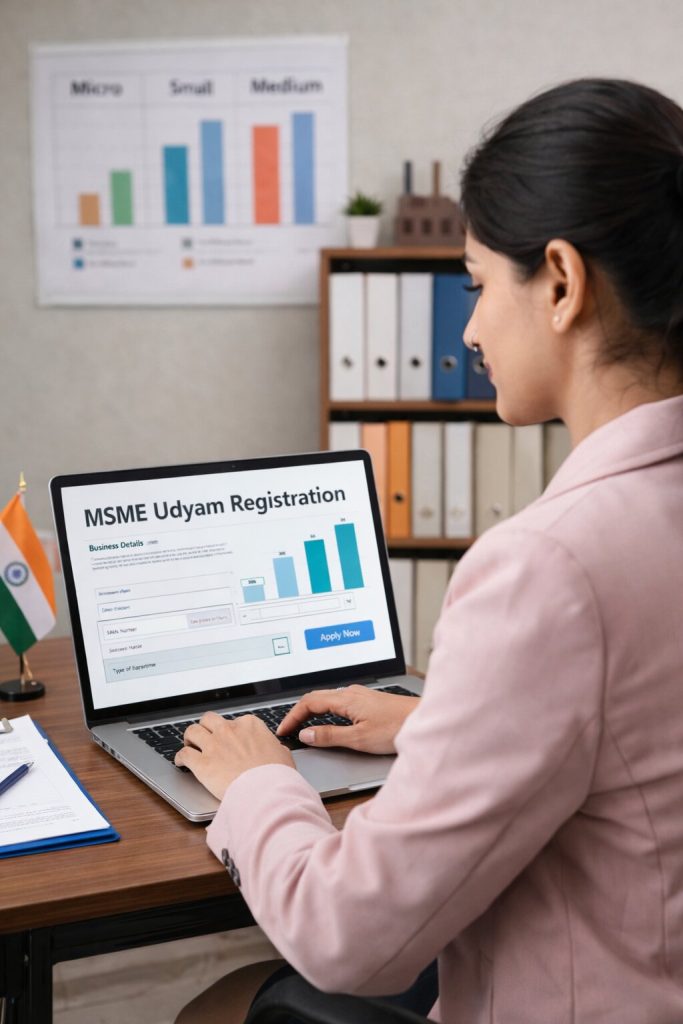
The portal is designed for different organisation types, including proprietorships, partnerships, Hindu Undivided Families (HUFs), and incorporated entities. The official portal clarifies whose Aadhaar is used in each case (proprietor, managing partner, or karta for HUF).
For a company, LLP, co-operative society, society, or trust, the portal and the legal framework both indicate that GSTIN and PAN are provided along with the authorised signatory’s Aadhaar.
What about trading businesses?
A common question is whether wholesale and retail traders can register. The Ministry decided to include retail and wholesale trade on the Udyam portal, but the Office Memorandum specifies that benefits are restricted to Priority Sector Lending only.
So, traders may be able to register, but they should not assume all benefits apply in the same way as for manufacturing or services.
What if you cannot register due to a missing PAN or GSTIN?
The RBI FAQ explains that the Ministry launched the Udyam Assist Platform (UAP) to help formalise Informal Micro Enterprises, with an online Udyam Assist Certificate. The RBI note also states that IMEs are defined as enterprises exempt from filing returns under the Central GST Act based on turnover, and that UAP is managed by the Small Industries Development Bank of India with designated agencies assisting registration.
For many micro entrepreneurs, this is an important alternative route to formal recognition, especially if they are outside thresholds that trigger GST return filing.
New MSME registration and MSME online registration step by step
This section is written to be usable even if you have never registered for anything online.
Before you start: a quick checklist
Have the following ready:
- Aadhaar number and the name exactly as in Aadhaar (you will verify with OTP).
- Mobile number linked to Aadhaar, because OTP authentication is part of the flow.
- PAN for the enterprise or PAN holder, depending on the type of organisation.
- GSTIN if applicable for your enterprise under the GST law. The portal’s form flow explicitly references GSTIN “as per applicability” and has an “Exempted” option in the GSTIN question.
- Basic business details: enterprise name, address(es), bank account details, and your major activity (manufacturing/services, and if trading).
Step one: Use the official portal and begin Aadhaar verification
On the Udyam registration page for new enterprises, you enter Aadhaar number and entrepreneur name, then proceed with Aadhaar OTP verification. The portal also includes a consent statement and notes that Aadhaar data will not be stored or shared by the system.
Practical tip: if the OTP is not arriving, first confirm your Aadhaar-linked mobile number is active and has network coverage.
Step two: PAN verification and organisation type
After Aadhaar verification, the workflow moves to PAN verification. The sample form shows you select the type of organisation, enter PAN, and the system uses government records to validate and populate relevant fields.
The same sample form also asks whether you have filed ITR for the previous year and whether you have a GSTIN (Yes/No/Exempted), which guides whether certain data is auto-filled or needs self-declaration.
Step three: Fill core enterprise details
You will fill in details such as:
- Mobile number and email
- Social category and gender details (as applicable)
- Enterprise name and unit/plant details
These fields are visible in the sample Udyam application form.
Step four: Add addresses for units and the official enterprise address
The sample form includes separate sections for plant/unit location details and the official address of the enterprise.
Tip: Keep your address consistent with the address used in PAN/GST records, where applicable, to reduce mismatches during verification.
Step five: Choose your major activity and NIC codes
Udyam registration requires you to declare your major activity (manufacturing or services) and select NIC codes for your activities. The sample form explicitly notes that one or more activities can be added.
If “NIC code” sounds technical, it is a standard classification code for your business activity. Choosing the closest accurate activity helps downstream verification and scheme mapping.
Step six: Add bank details
The form asks for bank name, IFSC code, and account number.
Tip: copy IFSC exactly; small typos here can slow later financial onboarding, even if registration completes.
Step seven: Investment and turnover details
This is where MSME classification becomes real.
- The portal indicates that PAN-based investment/turnover can be auto-populated from government databases, and the ecosystem is integrated with income tax and GSTIN systems.
- Where returns are not filed, the system may take information on a self-declaration basis, as shown both in the legal framework and in Udyam guidance.
- The sample form shows “Written Down Value (WDV)” input and a turnover section including export turnover, which aligns with the legal rule that exports are excluded from classification turnover.
Important: always enter truthful figures. The legal framework states that intentional misrepresentation or suppression of self-declared facts can attract penalties under the MSMED Act.
Step eight: Submit and download your certificate
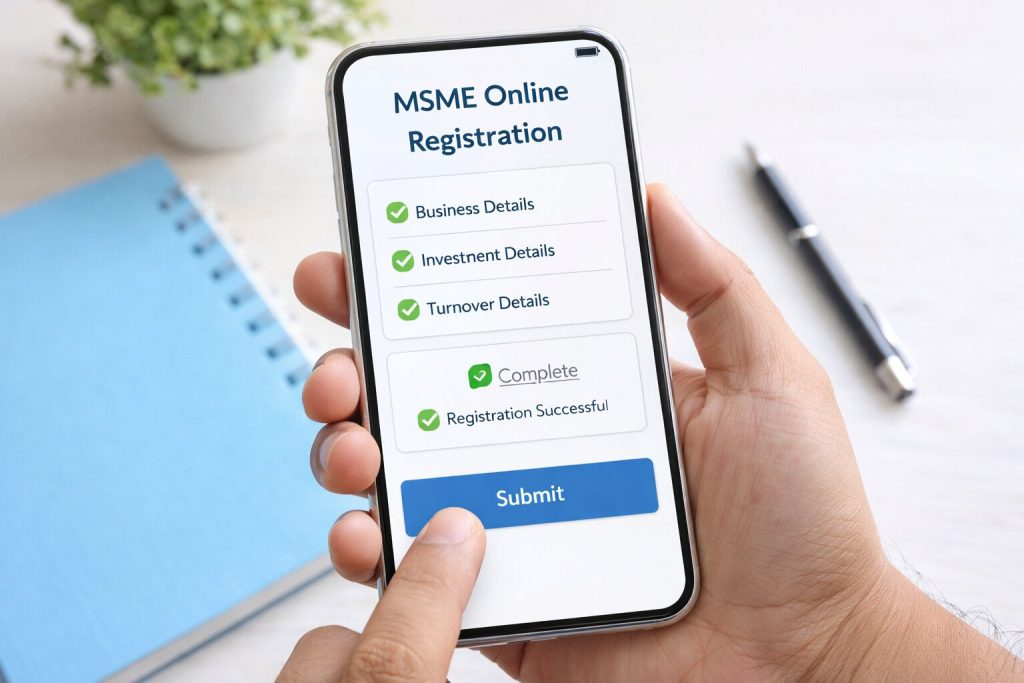
Once the form is successfully submitted (with final OTP), the process issues an online Udyam Registration Certificate. The portal emphasises that a permanent registration number is provided and that the certificate has a dynamic QR code for verification.
After you register for MSME status: Staying compliant and using your Udyam certificate
Keep your Udyam details updated
The framework requires enterprises with a Udyam Registration Number to update information online, including ITR and GST return details for the previous financial year. It also states that failure to update within the period specified on the portal can render the enterprise liable for suspension of status.
If you are running a small team, treat this like an annual compliance calendar item. It protects your classification status when you need it most, such as during a loan process or tender documentation.
Understand reclassification, including “graduation” and “reverse-graduation”
Two policy points are worth knowing:
- When your business grows into a higher category, the government has provided that an enterprise continues to avail non-tax benefits of its earlier category for three years from the date of the upward change (as per the amended notification).
- For reverse-graduation (sliding down), the framework indicates that the benefit of changed status is given with effect from 1st April of the financial year following the year in which such a change took place.
Also, for the revised definition announced for April 2025, the Ministry issued a clarification that the enhanced investment and turnover limits come into force from that date “for all purposes.”
Use DigiLocker to store and share proof
Official communication notes that the Udyam Registration Certificate can be pulled and stored electronically in DigiLocker, and that electronic records are legally recognised under the IT Act. It requests departments and stakeholders to accept the DigiLocker URC as valid and at par with the physical certificate.
This is particularly useful if you frequently need to share your MSME proof with banks, vendors, or procurement platforms.
Benefits beyond “just a certificate”
A good MSME classification and Udyam registration can open multiple practical doors:
Banking and formal credit
The RBI’s FAQ notes that for priority sector lending purposes, banks are guided by the classification recorded in the Udyam Registration Certificate. This makes the Udyam classification a practical document during credit discussions.
Public procurement opportunities for micro and small enterprises
Under the Public Procurement Policy FAQ issued by DCMSME, a minimum 25% share of total annual procurement by central ministries, departments, and PSUs is to be made from Micro and Small Enterprises, and sub-targets are earmarked for SC/ST-owned and women-owned MSEs.
If government or PSU procurement is part of your growth plan, ensuring your classification is correct is not optional. It is foundational documentation.
Delayed payment support visibility
The MSME Samadhaan portal describes that the MSMED Act contains provisions on delayed payments to Micro and Small Enterprises, and that states establish Micro and Small Enterprise Facilitation Councils (MSEFCs) for dispute settlement under those provisions.
Even if you never use it, knowing the mechanism exists can improve how you manage receivables and contracts.

Where Archbridge Capital fits in
Udyam registration does not automatically guarantee funding. What it does is make your enterprise easier to verify, categorise, and evaluate, which typically reduces friction in many formal processes.
If you are an MSME owner looking to expand the business, buy equipment, or strengthen working capital discipline, Archbridge Capital positions itself as a partner focused on fairness, transparency, and a streamlined borrowing experience.
On our MSME loan product page, we outline a promise of quick disbursal, flexible repayment options, minimal documentation, and dedicated business support, along with indicative loan amounts and tenures.
For businesses with an existing loan elsewhere, our balance transfer offering is positioned around better terms and faster processing, while emphasising transparent conditions.
For context, our company overview describes our focus on financial inclusion and serving families and businesses across Bihar, Uttar Pradesh, Rajasthan, Haryana, and nearby regions.
FAQs on MSME classification, Udyam Aadhaar registration, and MSME online registration
Is MSME registration free?
Yes. The official Udyam portal states that the registration process is totally free and that no costs or fees are to be paid to anyone. The legal framework also states that there is no fee for filing Udyam registration.
Which portal should I use to register for MSME?
Use the official government Udyam portal. It explicitly cautions that no private portal or agency is authorised to do MSME registration, except for government single-window systems.
What documents are required for MSME Udyam registration?
Udyam registration is designed as paperless and self-declaration-based, with “no documents or proof required to be uploaded” according to official portal guidance. In practice, Aadhaar is required, and PAN/GSTIN requirements depend on organisation type and GST applicability, with the portal workflow capturing these during Aadhaar and PAN verification steps.
Is GSTIN mandatory for Udyam registration?
For incorporated entities (company/LLP/society/trust), the legal framework indicates that GSTIN and PAN are provided along with Aadhaar. The portal form also references GSTIN “as per applicability” under the GST law and includes an “Exempted” option for GSTIN status in the workflow.
What is the difference between Udyam registration and Udyam Assist Platform?
The RBI explains that the Udyam Assist Platform helps formalise Informal Micro Enterprises that may not be able to register on the Udyam Registration Portal due to missing documents such as PAN or GSTIN, and it issues an Udyam Assist Certificate. The RBI also notes that the Udyam Assist Certificate is treated at par with the Udyam Registration Certificate for priority sector lending classification for micro enterprises.
How do I know my business is Micro, Small, or Medium under the latest MSME classification?
Use the updated investment and turnover thresholds effective from April 2025. Micro is up to ₹2.5 crore investment and ₹10 crore turnover; Small is up to ₹25 crore investment and ₹100 crore turnover; Medium is up to ₹125 crore investment and ₹500 crore turnover.
Do exports count in MSME turnover for classification?
No. The framework explicitly states that exports of goods or services are excluded while calculating turnover for MSME classification purposes.
I operate multiple units under the same PAN. Will they be treated separately?
No. The framework states that all units with GSTIN listed against the same PAN are treated collectively as one enterprise, and aggregate turnover and investment are considered for classification.