The Indian economic landscape is currently defined by the resilience and rapid formalization of its Micro, Small, and Medium Enterprises (MSMEs). As the nation marches toward its goal of becoming a five trillion dollar economy, the MSME sector serves as the primary engine of growth, contributing approximately 30 percent to the national Gross Domestic Product (GDP) and nearly 45 percent of total exports. However, for many entrepreneurs, the path to expansion is often obstructed by the weight of existing debt. When a business is locked into a high-interest loan taken during a period of lower creditworthiness or higher market volatility, the monthly interest outgo can stifle innovation and liquidity. This is where the strategic concept of a Loan Balance Transfer emerges as a critical tool for financial optimization.

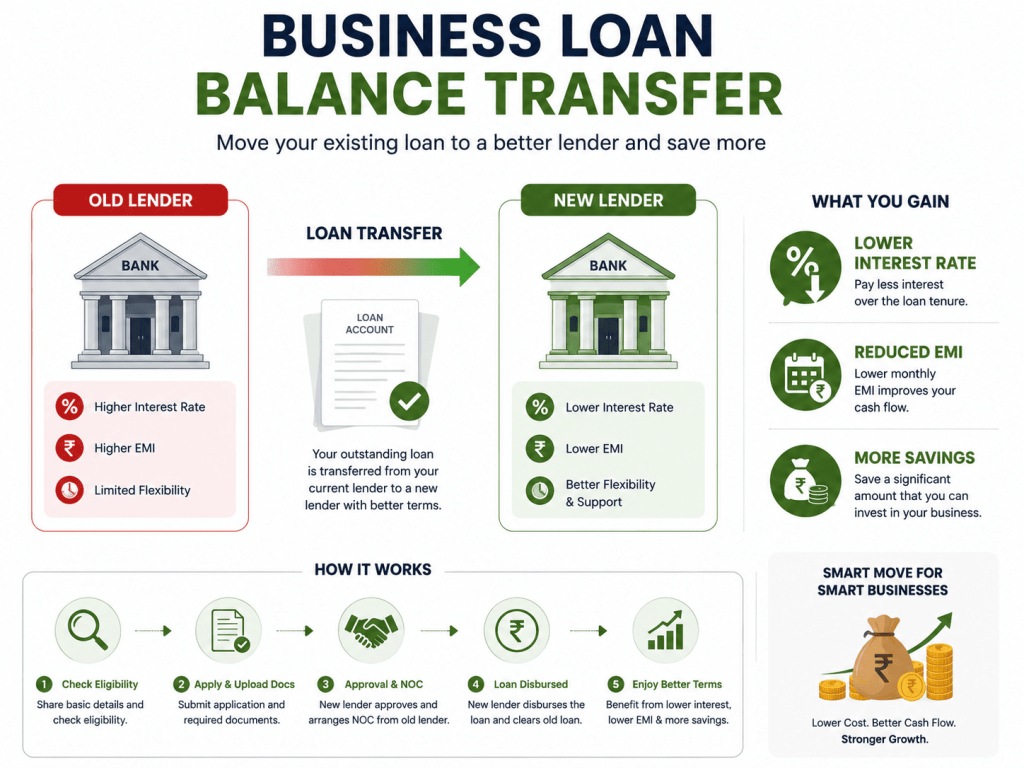
A business loan balance transfer is essentially the process of moving an outstanding loan from one financial institution to another to benefit from more favorable terms. These terms typically include lower interest rates, reduced Equated Monthly Installments (EMIs), or extended repayment tenures. For a business owner, this is not merely a change of lenders but a recalibration of their capital structure to align with current market realities and the improved financial health of their enterprise. In a financial ecosystem where the credit outstanding of the MSME sector has grown to approximately 31.3 lakh crore as of March 2025, the ability to refinance debt efficiently is a major competitive advantage.
The Strategic Importance of Debt Refinancing in the 2025 Economic Climate
The year 2025 has brought significant shifts in the regulatory and lending environment in India. The Reserve Bank of India (RBI) has introduced new directions regarding prepayment charges, and the government has expanded MSME classification limits to allow businesses to scale without losing vital benefits. In this context, a Business Loan Transfer is no longer a desperate measure for distressed firms but a sophisticated move for healthy businesses looking to free up cash flow for reinvestment.
The MSME sector in India is highly fragmented, with over 98 percent of enterprises classified as micro enterprises. These businesses often face higher borrowing costs initially due to a lack of established credit history or the absence of tangible collateral. As these businesses mature, their risk profile improves. A business that started three years ago might have secured a loan at 18 percent per annum. Today, with a steady track record and updated Udyam registration, that same business might be eligible for a loan at 14 percent or 15 percent. Over a tenure of seven to ten years, this difference of 3 percent can translate into lakhs of rupees in savings, which can be redirected toward purchasing new machinery or hiring skilled labor.
Key Terminology for the Layman
To navigate the world of finance, one must understand the language used by lenders. For many business owners, these terms can be confusing when encountered for the first time.
- Equated Monthly Installment (EMI): This is a fixed payment amount made by a borrower to a lender at a specified date each calendar month. EMIs are used to pay off both interest and principal each month so that over a specified number of years, the loan is paid off in full.
- Principal Amount: This refers to the original sum of money borrowed or the amount still owed on a loan, excluding interest.
- Interest Rate: This is the percentage of the principal charged by the lender for the use of its money.
- Reducing Balance Method: This is a way of calculating interest where the interest is charged only on the remaining principal amount at the end of every month. As you pay back the loan, the principal decreases, and so does the interest amount. This is generally more favorable for the borrower than a flat interest rate. You can know more about ‘reducing balance method’ and secured business loans in our latest blog.
- Amortization Schedule: This is a table detailing each periodic payment on a loan. It shows the amount of principal and the amount of interest that make up each payment until the loan is paid off.
- Collateral: This is an asset, such as property or machinery, that a borrower offers to a lender as security for a loan. If the borrower stops making the promised loan payments, the lender can seize the collateral to recover its losses.
Why MSMEs Should Consider a Loan Balance Transfer
The decision to initiate a Balance Transfer is usually driven by a combination of financial and operational factors. It is not just about the numbers on a spreadsheet; it is about the long-term sustainability of the business.
1. Significant Interest Savings
The most obvious benefit of a Loan Balance Transfer is the reduction in interest rates. The Indian lending market is diverse, with public sector banks, private banks, and Non-Banking Financial Companies (NBFCs) like Archbridge Capital offering a wide range of rates. While some traditional banks might have lower base rates, specialized NBFCs often provide more flexible structures and faster processing times that can outweigh a slight difference in interest.
| Lender Category | Typical Interest Rate Range (p.a.) | Approval Speed |
| Public Sector Banks | 8.5% – 13.5% | 15 – 30 Days |
| Private Sector Banks | 10.5% – 22.5% | 10 – 20 Days |
| Specialized NBFCs | 12% – 28% | 2 – 7 Days |
| Archbridge Capital | Competitive & Customized | Within 48-72 Hours |
Note: Interest rates are indicative and depend on business profile and collateral.
2. Lowering the EMI Burden
High EMIs can put a strain on a business’s daily liquidity, making it difficult to pay suppliers or meet payroll during lean months. By transferring the loan to a lender that offers a lower rate or a longer tenure, the business can significantly reduce its monthly outgo. This improved cash flow acts as a buffer against seasonal fluctuations in revenue.
3. Access to Additional Capital (Top-Up Loans)
One of the most attractive features of moving a loan to Archbridge Capital is access to additional capital. A top-up loan is an additional amount sanctioned over your existing loan balance. Since the lender has already verified your documents and business stability for the balance transfer, they can often provide these extra funds with minimal additional paperwork. This capital can be used for expansion, inventory stocking, or technology upgrades.
4. Improving Service and Transparency
Many MSME owners express dissatisfaction with their current lenders due to hidden charges, poor customer service, or a lack of transparency in how interest rates are calculated. Switching to a partner like Archbridge Capital, which prioritizes a simple and streamlined journey, ensures that the borrower is always informed. Transparent terms and a dedicated support team help in building a long-term relationship based on trust rather than just a transaction.
Analyzing the Regional MSME Credit Trends
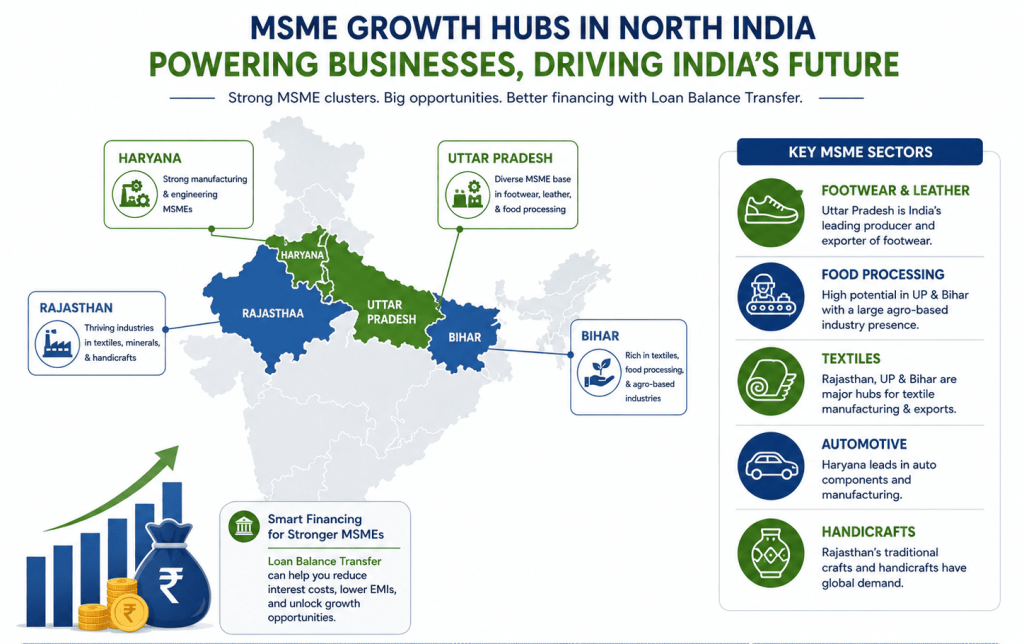
The demand for efficient debt management is particularly visible in Northern and Eastern India. States like Uttar Pradesh, Bihar, Haryana, and Rajasthan have become hubs of entrepreneurial activity, each with its unique economic drivers.
Uttar Pradesh: The MSME Giant
Uttar Pradesh accounts for approximately 86.3 lakh MSME registrations, representing 11 percent of the national total. The state’s focus on the “One District One Product” (ODOP) initiative has led to the growth of specific clusters, such as footwear in Agra and brassware in Moradabad. These businesses often require capital for modernization, and a loan balance transfer can help them transition from high-interest informal debt to structured, affordable formal credit.
Bihar: Emerging Opportunities
In Bihar, the government has approved significant grants for small businesses, and sectors like food processing and dairy are identified as key growth drivers. As these small units scale, their need for professional lending partners increases. Archbridge Capital’s presence in Bihar ensures that local businesses have access to the same quality of financial services as those in major metropolitan areas.
Haryana and Rajasthan: Industrial and Trading Hubs
Haryana, particularly regions like Gurugram and Faridabad, is a leader in automotive components and IT services. Rajasthan is known for its stone industry, textiles, and handicrafts. These sectors are capital-intensive and often carry significant debt. For these businesses, even a 1 percent reduction in interest via a loan balance transfer can result in substantial annual savings.
| State | Key MSME Clusters | Credit Growth Trend (2025) |
| Uttar Pradesh | Agra (Footwear), Bareilly (Furniture) | Robust growth in manufacturing credit |
| Bihar | Muzaffarpur (Food Processing) | Increasing demand for micro loans |
| Haryana | Gurugram (Auto/IT) | High potential for technology upgrades |
| Rajasthan | Jaipur (Textiles/Handicrafts) | Growing interest in export financing |
Navigating the Regulatory Landscape: RBI Guidelines in 2025
For a business owner, understanding the rules set by the Reserve Bank of India (RBI) is crucial to avoid being overcharged. A major concern during a balance transfer is the “Foreclosure Charge” or “Prepayment Penalty.” This is the fee a lender charges when you pay off your loan earlier than the agreed tenure.
According to the Reserve Bank of India (Pre-payment Charges on Loans) Directions, 2025, several protections have been put in place for Micro and Small Enterprises (MSEs):
- Floating Rate Loans: Lenders are generally not permitted to levy prepayment charges on floating rate term loans sanctioned to MSEs.
- Sanctioned Limits: For many NBFCs, no prepayment charges can be levied on loans with a sanctioned limit of up to ₹50 lakh.
- Transparency: All charges must be clearly disclosed in the “Key Facts Statement” (KFS) provided at the time of loan sanction. If a charge was not disclosed upfront, it cannot be levied later.
These regulations are designed to prevent “exit barriers” that stop businesses from seeking better terms elsewhere. At Archbridge Capital, the philosophy is to empower the borrower, which includes offering transparent terms and zero hidden charges.
How to Transfer Your Business Loan to Archbridge Capital
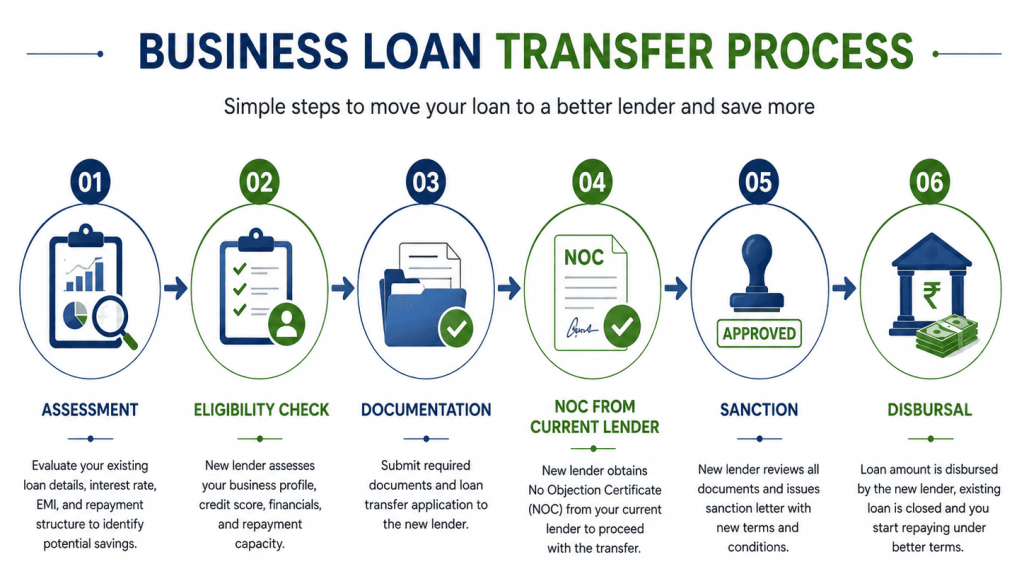
The process of transferring a loan might seem technical, but it is designed to be as smooth as possible for the entrepreneur.
Step 1: The Initial Assessment
The first step is to evaluate your current loan. Look at your latest loan statement to find your outstanding principal, current interest rate, and the remaining number of months. Use our calculator to see how much you could save if you switched to a lower interest rate.
Step 2: Checking Eligibility
Archbridge Capital welcomes businesses from various sectors, including manufacturing, trading, and services. While individual requirements may vary, general eligibility includes:
- An active business with at least 2 to 3 years of operations.
- A stable repayment history on the existing loan for at least 12 months.
- A healthy credit score, typically 700 or above, indicates financial discipline.
Step 3: Document Preparation
Documentation is the backbone of the lending process. To ensure a fast approval, have the following ready:
- KYC Documents: Aadhaar card, PAN card, and business registration proof (like Udyam Registration).
- Financial Statements: GST returns, bank statements for the last 6 to 12 months, and ITRs for the last two years.
- Loan Documents: The sanction letter and the latest account statement from your current lender.
- Property Documents: Since Archbridge Capital specializes in secured loans, you will need the documents for the property being used as collateral
Step 4: Obtaining the NOC and Foreclosure Letter
Once Archbridge Capital provides an “In-Principle Approval,” for loan balance transfer, you must request a “Foreclosure Letter” and a “No Objection Certificate” (NOC) from your current bank. The foreclosure letter states the exact amount required to close the account on a specific date. The NOC confirms that the current lender has no objection to you moving your debt to a new institution.
Step 5: Sanction and Disbursal
After a technical and legal verification of your documents, Archbridge Capital will issue a formal sanction letter. Once you accept the terms, Archbridge Capital will pay the outstanding amount directly to your previous lender. Your old loan is closed, your original property documents are transitioned to the new account, and you begin your new, more affordable journey with Archbridge Capital.
Calculating the Real Impact: A Practical Example
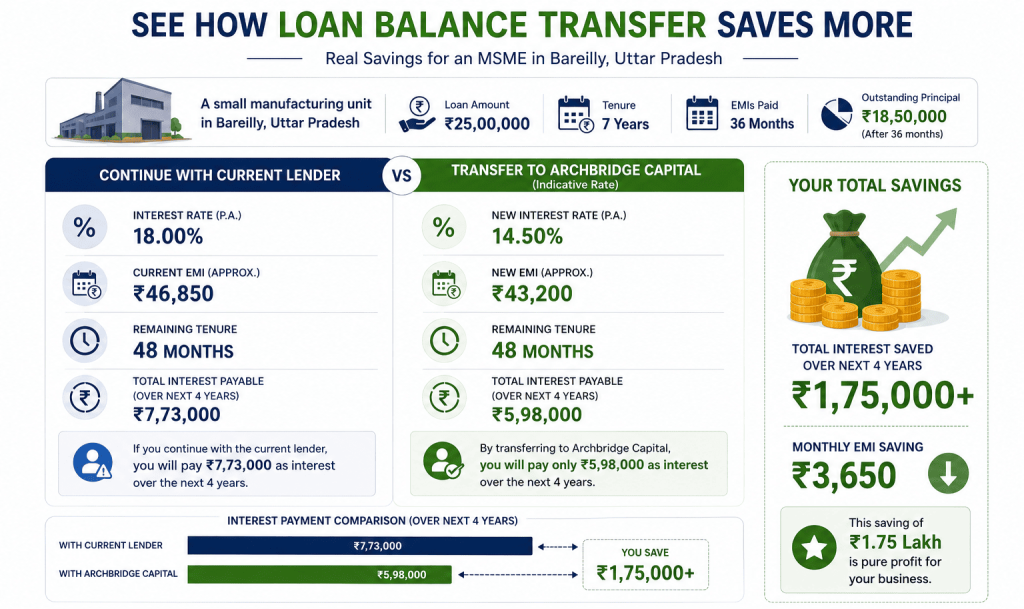
Let us look at a hypothetical case of a small manufacturing unit in Bareilly, Uttar Pradesh, as shown in the infographic. This saving of ₹1.75 lakh is pure profit for the business. Furthermore, if the owner opts for a Top-Up loan of ₹5,00,000 at the same time, they can upgrade their machinery without the stress of a completely new, high-interest loan.
Common Pitfalls to Avoid During a Balance Transfer
While the benefits are significant, entrepreneurs should be mindful of certain factors to ensure the transfer is truly profitable.
1. Ignoring the Total Cost of Transfer
A lower interest rate is great, but you must also account for the processing fees of the new lender, the stamp duty for the new loan agreement, and any legal charges. If the cost of the transfer is higher than the interest you will save, then the move might not make sense. Always calculate the “Break-even Point”—the time it takes for your monthly savings to cover the initial costs of the transfer.
2. Overlooking Repayment Terms
Sometimes, a lender might offer a lower EMI by significantly extending the loan tenure. While this helps with monthly cash flow, it might increase the total interest you pay over the life of the loan. Ensure you balance a comfortable monthly payment with a reasonable total interest outgo.
3. Delays in Getting the NOC
Some traditional banks might take time to issue the foreclosure letter or return the original property documents. It is important to stay proactive and follow up regularly to ensure that the transfer happens within the validity period of the new lender’s offer.
The Future of MSME Lending: Moving Towards Flexibility
The Indian lending landscape is rapidly evolving with the integration of technology. Digital KYC, AI-driven credit assessment, and automated documentation are making loans more accessible. While Archbridge Capital is currently a leading provider in secured lending, the focus remains on adapting to the needs of the borrower.
The distinction between secured and unsecured loans is a key area of consideration for many MSMEs. Secured loans, which require collateral, typically offer larger amounts and lower interest rates over longer tenures. This makes them ideal for major capital investments. Unsecured loans, on the other hand, provide quick access to smaller amounts without the need to pledge assets. Both play a vital role in a business’s lifecycle. For instance, a business might use a secured loan for its factory building and an unsecured line of credit for its daily operational needs.
At Archbridge Capital, we believe in supporting every stage of a business’s growth. Whether you are a startup in its first year or an established enterprise looking to scale across states, our goal is to provide financial solutions that are as dynamic as your business. Our commitment to financial inclusion means we look beyond just the numbers to understand the person and the vision behind the business.
Conclusion: Empowering Your Business for the Long Term

A business loan balance transfer is more than just a financial transaction; it is a strategic step toward financial freedom. By optimizing your debt, you are not just saving money; you are creating the liquidity and the confidence needed to seize new market opportunities. In the competitive environment of 2025, where every rupee counts, a partner like Archbridge Capital can provide the expertise and the support needed to navigate this transition smoothly.
If you are currently paying a high interest rate on your business loan, now is the time to evaluate your options. With transparent policies, a digital-first approach, and a deep understanding of the MSME ecosystem in Northern and Eastern India, Archbridge Capital is ready to help you bridge the gap between where your business is today and where you want it to be tomorrow.
Contact us today and take the first step toward a more profitable and sustainable future for your enterprise.
Frequently Asked Questions (FAQs)
1. Does transferring my business loan affect my CIBIL score?
Initially, when a new lender checks your credit history, there might be a very minor, temporary dip in your score due to the “Hard Inquiry.” However, in the long run, lower EMIs and timely repayments on your new loan will significantly improve your creditworthiness and boost your score.
2. Can I transfer my loan if I have already paid off 50% of it?
Yes, a balance transfer can be initiated at any stage of the loan, provided the remaining principal and tenure make it financially viable. Most businesses find the greatest benefit when they transfer their loans during the first half of the tenure, as this is when the interest component of the EMI is the highest.
3. Is the Udyam Registration mandatory for a balance transfer?
While not always mandatory for every type of loan, having a Udyam Registration is highly recommended. It proves your status as a formal enterprise and can help you qualify for lower interest rates and various government-backed benefits that Archbridge Capital can help you navigate.
4. What happens to my original property documents during the transfer?
During a secured loan balance transfer, the new lender (Archbridge Capital) will coordinate with your old bank to ensure the safe handover of the original documents. Once the old loan is paid off, the lien (legal claim) of the old bank is removed, and a new lien is established in favor of Archbridge Capital.
5. Can I get a top-up loan even if my business hasn’t grown significantly?
Eligibility for a top-up loan depends on your current repayment history and the value of your collateral. If you have been disciplined with your EMIs and your property value is sufficient, you can often secure additional funds even for general working capital needs.