

Reducing high monthly loan payments (EMIs) is crucial for small and medium businesses to maintain healthy cash flow and fuel growth. This guide explores practical strategies – from refinancing at lower rates on refinance, to changing tenure, making part prepayments, and using Archbridge’s EMI and repayment schedule calculators. We explain each option in simple terms, with examples, checklists, and a comparison table of refinance strategies. By the end, you’ll have a complete roadmap (including a decision flowchart) to cut your EMI burden and boost your cash flow, while also seeing how Archbridge Capital can assist with tailored business loan solutions.
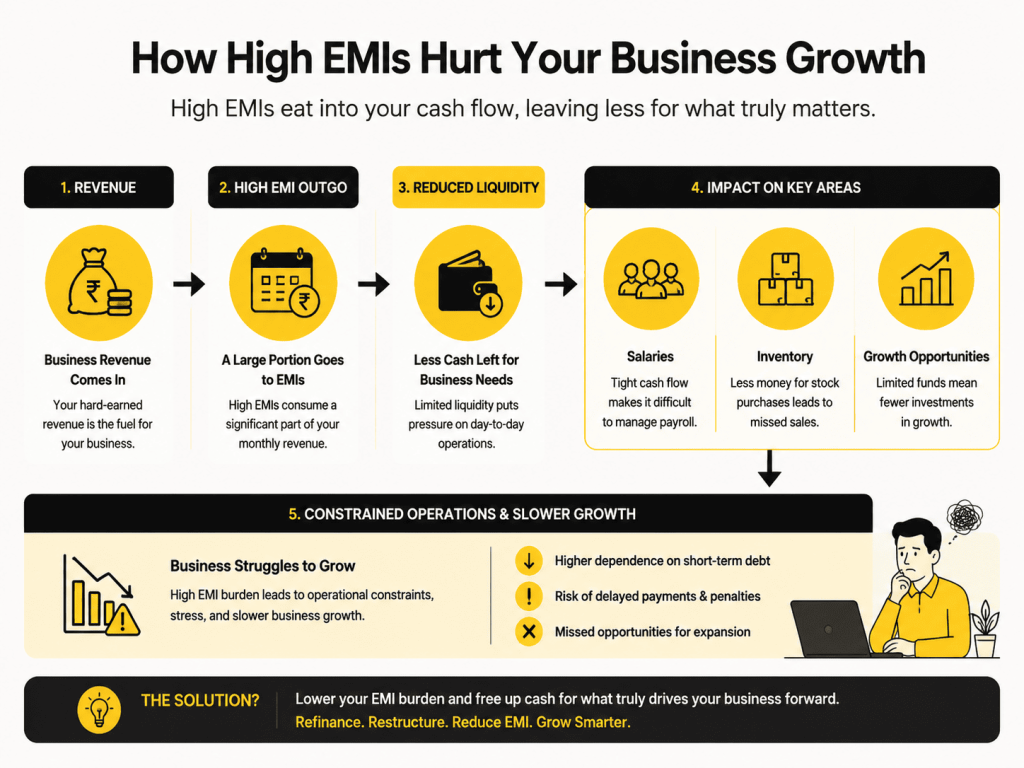
Why High EMIs Hurt Your Business Growth
Businesses with heavy loan EMIs often struggle with tight cash flow. When a large share of revenue goes to loan repayments, it leaves little for inventory, salaries, or growth investments. High EMIs can force a firm to take on short-term debt just to cover expenses, or even miss out on new opportunities. In contrast, lowering your EMI (monthly installment) through better loan terms frees up cash. This extra liquidity can be used for stock, equipment, or simply as a buffer against slow months. In short, reducing EMI burdens strengthens financial stability and accelerates expansion.
Refinance and Balance Transfer for Lower EMI
Balance transfer or loan refinancing means moving your existing loan to a new lender (or renegotiating with your current lender) at a lower interest rate or better terms. Since EMI is directly related to interest rate, even a small rate cut can significantly reduce your EMI and total interest paid. For example, refinancing a ₹10 lakh loan from 12% to 9% per annum (same tenure) cuts the EMI by ~₹1,500 per month (saving ~₹18,000 a year. Archbridge Capital’s flexible business loans often come with competitive rates, so refinancing your SME loan through us could lower your EMI and overall cost.
Steps for a loan balance transfer:
- Research competitive rates. Use online tools or consult lenders to find the lowest rates on refinance available for your business. NBFCs like Archbridge often have attractive rates for MSMEs.
- Compare offers. Use a commercial loan EMI calculator and a repayment schedule calculator to estimate the new EMI and interest savings.
- Check costs. Balance transfers may involve a processing fee or foreclose charge on the old loan. However, RBI rules now waive prepayment charges on most floating-rate business loans from Jan 2026, making transfers easier. Always calculate if the EMI savings outweigh any fees.
- Apply and document. Apply with the new lender (like Archbridge) providing your existing loan statement and business documents. Once approved, the new lender pays off the old loan and issues you a new loan with lower EMI.
Tip: Read Archbridge’s Business Loan Balance Transfer Guide for MSMEs to see when and how to switch loans.
Restructuring Loan Tenure: Stretch to Stretch Less
If refinancing isn’t possible or rates are similar, extending the loan tenure is a quick way to lower EMIs. By increasing the number of payments (length of loan), each installment becomes smaller. For instance, extending a 5-year loan to 7 years can reduce EMI by 20–30%, depending on rates. The trade-off is you’ll pay interest longer, so total cost rises.
However, when cash flow is very tight, stretching out payments can free up month-to-month liquidity. Archbridge Capital offers flexible terms; talk to our loan advisors about extending your tenure under our working capital loans so that monthly outgo fits your revenue cycle.
Example: A ₹20 lakh loan at 10% p.a. for 5 years has an EMI of ₹42,475. If restructured to 7 years at the same rate, EMI falls to ₹35,046. That is an immediate saving of ₹7,429 per month (≈₹89,150/year), at the expense of 2 more years of payments.
Part Prepayment and Foreclosure Strategies
When you have spare funds (say from a cash surplus or after selling an asset), consider part prepayment of your loan. A part prepayment is paying a chunk of your principal ahead of schedule. This reduces the outstanding balance, so future EMIs drop (if tenure is fixed), or the loan ends sooner (if EMI is fixed). For example, paying ₹2 lakh extra on a ₹10 lakh loan can cut both EMI and overall interest.
Good news: RBI’s latest rules ban penalty fees on prepayments for most floating-rate business loans from Jan 2026. That means you can freely make part prepayments on Archbridge’s floating-rate loans without extra charge. Even if your loan is fixed-rate, check your lender’s policy; smaller banks or NBFCs may allow some free prepayments.
If your goal is to exit debt quickly, consider foreclosure (full prepayment). With floating-rate business loans now penalty-free, clearing the loan early can save a bundle of interest. After prepaying, ask for a revised statement and use our Repayment Schedule Calculator to confirm the new EMI or tenure adjustment.
Loan Top-up vs Refinancing: What’s Best?
A top-up loan gives you additional credit (extra funds) on top of your existing loan, usually at similar interest and with the same lender. This is useful if you need more cash (e.g. to buy new equipment) while keeping one EMI. But top-ups increase your total loan and EMI, so they don’t reduce EMI.
On the other hand, loan refinancing (described above) replaces your old loan. If you combine refinancing with a top-up, you get new funds and possibly lower EMI. For instance, refinance your ₹10 lakh loan at 9%, get a ₹3 lakh top-up at the same rate: now your total loan is ₹13 lakh at 9%. The EMI rises compared to the original ₹10 lakh, but it may still be lower per ₹1 lakh borrowed than before. Archbridge offers both top-up and refinance options; discuss your cash needs with us to pick the best solution.
| Option | When to Use | Effect on EMI | Considerations |
|---|---|---|---|
| Refinancing (Balance Transfer) | Current EMI too high due to high interest | Reduces EMI (if new rate/tenure is lower) | Check processing fees and new rate |
| Extend Tenure | Cash flow tight, need to lower monthly outgo | Reduces EMI (more installments) | Longer loan life, more total interest |
| Part Prepayment | Lump-sum cash available to lower debt | Reduces EMI (or shortens loan) | Best for floating-rate loans (no penalty) |
| Loan Top-up | Need extra funds without switching lenders | Increases EMI (but provides additional cash) | Funds at existing rate; raises total EMI |
Practical Tips to Align EMI with Cashflow
- Time repayments to revenue cycles. If your business has seasonal highs (e.g. retail peak months), consider payment schedules that align with those periods. Archbridge’s advisors can structure installments (monthly/quarterly) to match your inflow.
- Maintain healthy credit. On-time EMI payments build credit history, enabling you to negotiate better refinance rate. Avoid late payments, as they hurt your credit score and worsen terms.
- Optimize loan amount. Borrow only what you need. Over-borrowing means larger EMI with no productive use. Use our Repayment Schedule Calculator to plan the minimum required loan for your project, keeping EMIs manageable.
- Negotiate terms. Don’t hesitate to ask lenders for a better deal or waive fees. Showing multiple loan offers (for example, from Archbridge and other banks) can give you leverage to demand lower rates.
- Leverage collateral if available. Secured loans (backed by property or equipment) often carry much lower interest than unsecured loan. If you own business assets, using them as collateral in refinancing can drastically cut your EMI.
Using Archbridge’s Tools for Planning
Archbridge Capital provides 2-in-1 online EMI calculator and repayment scheduler to help you visualize the impact of any change. Enter your loan amount, interest rate, and tenure in the Commercial Loan EMI Calculator to see new EMIs if you refinance at a different rate. You can also get a month-by-month breakdown and total interest outlay. These tools take the guesswork out of numbers, ensuring you understand how much you save before applying.
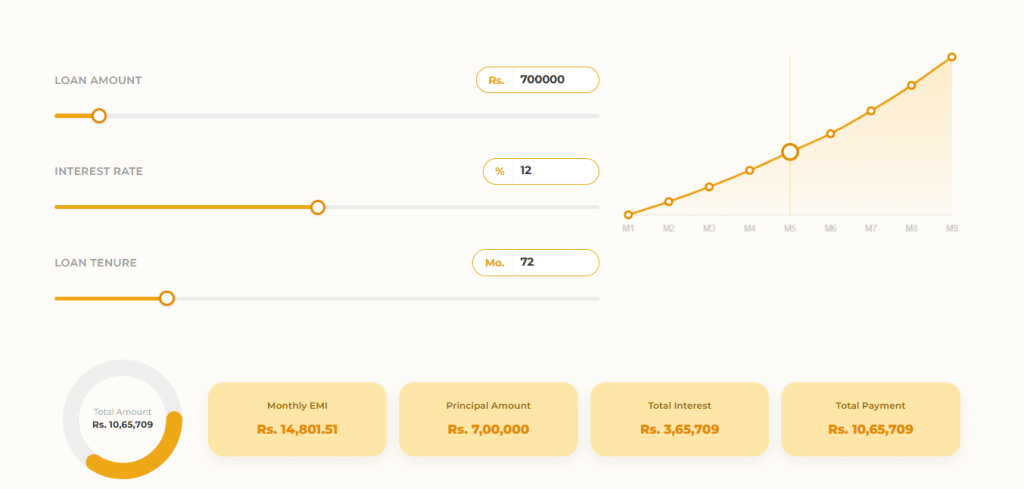
- Repayment Schedule Calculator: Project your full amortization schedule. Use it to compare current vs revised payment plans side by side.
- Commercial Loan EMI Calculator: Quickly estimate new EMIs for any rate/tenure combination. Great for “what if” scenarios like dropping 1–2% interest or extending by 1–2 years.
By playing with these calculators, you can convincingly show your accountant or bank how refinancing or restructuring will benefit your business.
How to Choose the Right Lender for Refinancing
When considering a loan transfer, compare lenders on more than just headline rates. Key factors:
- Interest rate and floating vs fixed: Archbridge offers competitive fixed and floating rates for MSMEs. Floating rates track the market, so if rates have fallen since your original loan, a floating-rate refinance could save more.
- Processing fees & hidden charges: Some lenders charge high processing fees or legal costs. Archbridge discloses all fees upfront; we’ll compare total cost of refinance (fees + new interest) to ensure it’s worth it.
- Speed of funding: If you need quick relief, an NBFC like Archbridge can often approve and disburse faster than larger banks. Fast processing means lower interim interest costs on old loan.
- Customer support and flexibility: Archbridge’s relationship managers can help restructure loans (e.g. tenure extension, partial payment plans) based on your evolving needs. Choose a lender willing to customize terms.
Checklist: Before refinancing, ensure you have:
- Up-to-date financials (6–12 months of bank statements, financial reports).
- Existing loan statement (to know outstanding principal and EMI).
- Proof of collateral (if applying for secured refinance).
- Business profile (Udyam registration, GST, etc.) to show legitimacy.
Archbridge Capital’s loan application guide helps you through document submission with minimal hassle.
Decision Flowchart: Should You Refinance or Restructure?
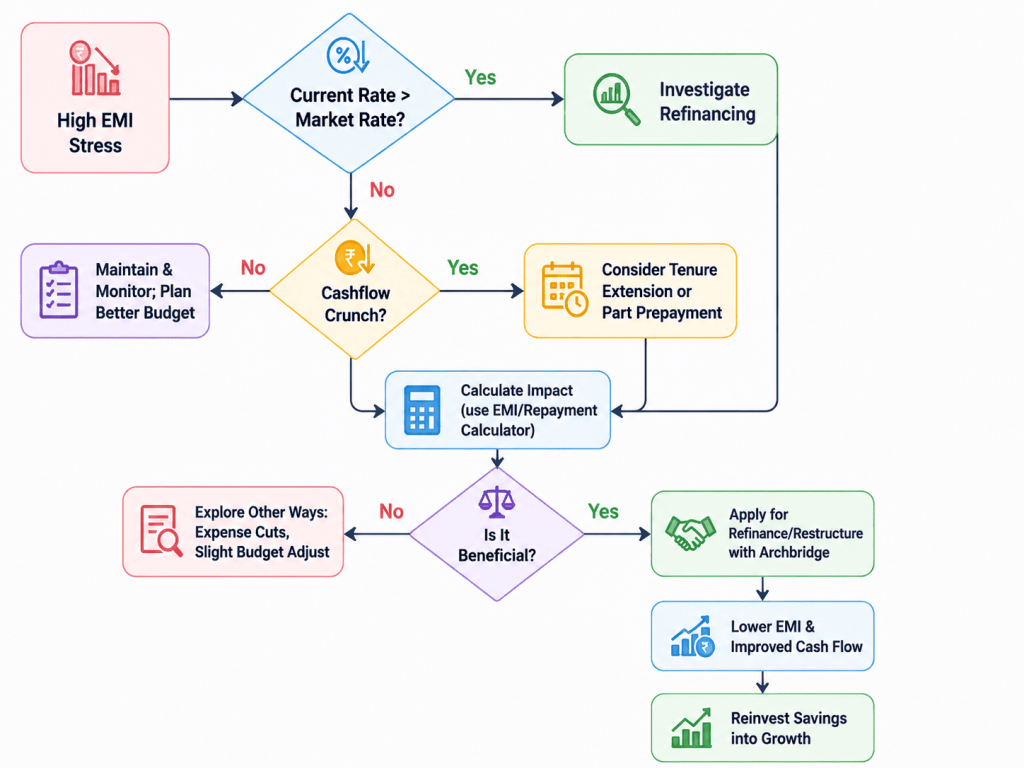
This flowchart shows that if your existing loan’s rate is higher than current market rates, refinancing (balance transfer) is usually the first step. If not, but you still need relief, look at extending tenure or making part payments. Use Archbridge’s calculators (step G) at each decision to quantify benefits. The final step is to apply with Archbridge Capital, which can handle the refinance, restructure, or disbursement swiftly.
Sample Case Study
Meet Rajesh, owner of a textile trading firm. He has a ₹15 lakh business loan at 11.5% p.a. for 5 years (EMI ≈ ₹33,800). After 2 years, RBI cuts rates and banks are offering 9.5% for similar loans. Rajesh uses Archbridge’s EMI calculator: refinancing at 9.5% for the remaining 3 years drops EMI to ≈ ₹31,000 – saving ₹2,800 monthly. Even after a 1% processing fee, he nets a large interest saving. He transfers the loan to Archbridge Capital’s MSME loan, drops EMI, and uses the extra cash to restock faster. In 6 months, he has expanded inventory and landed a new contract, thanks to the freed-up funds.
(Note: Figures are illustrative. Actual EMI varies by exact tenure and formula.)
Frequently Asked Questions (FAQs)
- Can refinancing always reduce my EMI?
Refinancing reduces EMI if you secure a lower interest rate or extend the loan term (or both). If your new rate plus fees results in lower monthly cost, then yes. Always run the numbers with a calculator before deciding. - What is part prepayment and how does it help?
Part prepayment is paying extra on top of your regular EMI. It reduces the remaining principal, which can lower future EMIs or shorten tenure. Thanks to RBI’s 2026 rule, floating-rate business loans now allow penalty-free prepayments, so Archbridge borrowers can prepay without charges. - Should I pick a longer tenure to reduce EMI?
A longer tenure lowers each EMI, but increases total interest paid. Use tenure extension if you urgently need lower monthly payments. If you can manage, also consider refinancing or prepayment first, as those options can lower EMI and possibly shorten tenure. - How is a top-up loan different from refinancing?
A top-up adds a separate loan on top of your existing one (often at similar rate), increasing your EMI since the total loan is higher. Refinancing replaces the entire old loan with a new one, ideally at better terms, reducing EMI or interest cost. Sometimes people refinance and top-up together to get new funds at a good rate. - Will there be any fees if I transfer my loan to Archbridge?
Archbridge Capital has transparent charges. There is a standard processing fee, but we will calculate your net savings before you decide. Under RBI rules, prepayment penalties are waived for floating-rate loans, so you won’t face surprise foreclosure fees if you move to Archbridge. - How do I calculate new EMI or savings?
Use Archbridge’s online calculators. The Commercial Loan EMI Calculator will show you monthly payment for any loan amount, rate, and term. The Repayment Schedule Calculator will show how each payment splits into interest/principal and the new ending balance. These tools make it easy to compare your current plan vs a refinance plan side by side. - Why choose Archbridge Capital for refinancing?
Archbridge is an MSME-focused NBFC with fast approvals and personalized service. We offer competitive rates, flexible tenors, and special features like interest-only initial installments for cash-flow flexibility. As a specialized lender, we understand small businesses’ needs. Read our Secured Business Loans guide to learn more about our terms.
Quick Checklist to Reduce Your EMI Burden
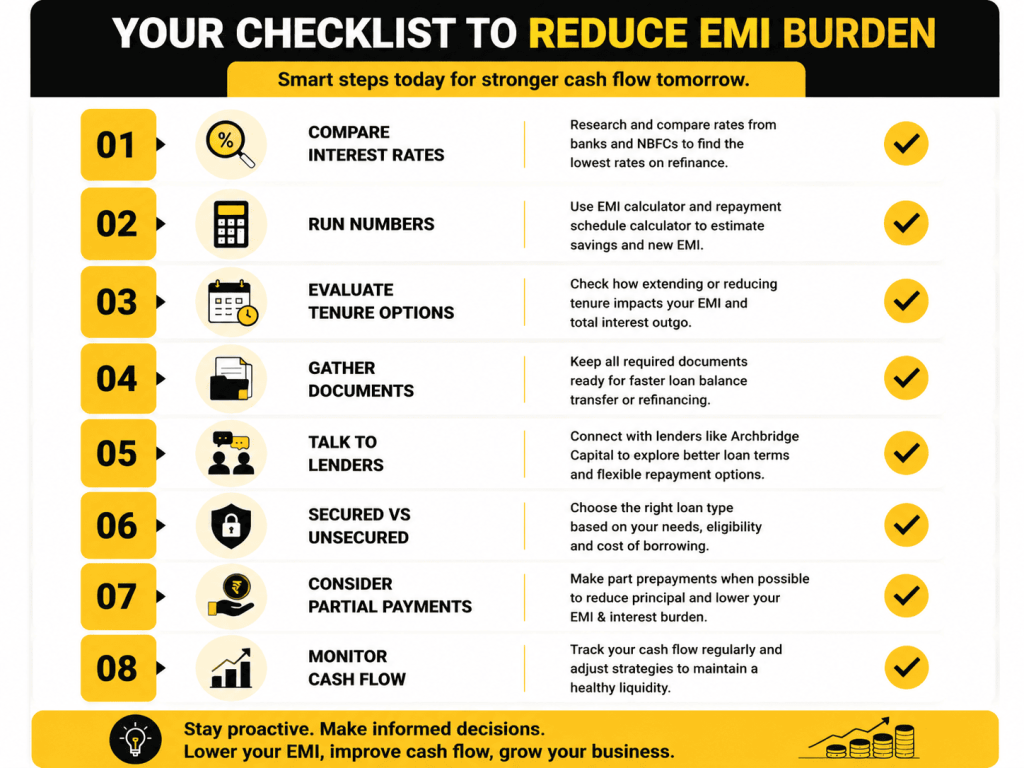
- Compare interest rates: Check if banks/NBFCs offer better rates than your current loan.
- Run the numbers: Use an EMI calculator to estimate savings before changing anything.
- Evaluate loan tenure: See how extending or shortening the loan term affects EMI and interest total.
- Gather documents: Ensure you have financials and loan statements ready for any new loan application.
- Talk to lenders: Discuss options with your current bank and with Archbridge Capital. Sometimes lenders may renegotiate without a full balance transfer.
- Consider secured vs unsecured: If possible, use collateral to lower the refinance rate.
- Plan partial payments: Any surplus funds could be used to make a one-time prepayment, instantly cutting future EMIs.
- Monitor cash flow: Align your loan payments with your revenue cycle for optimal affordability.
Accelerate Growth by Cutting Costs, Not Corners
Reducing EMI burden doesn’t mean taking on riskier debt; it means optimizing your existing loans. Archbridge Capital encourages prudent borrowing and offers refinancing as a tool to reduce costs. By restructuring smartly and using calculators and strategies outlined above, you can turn a stressfully high EMI into manageable payments.
Ready to Lower Your EMIs? Talk to Archbridge Capital!
If your current loan is heavy on your cash flow, consider refinancing with Archbridge Capital. We specialize in MSME business loans and can help you find the best rates on refinance suitable for your needs. Use our online EMI calculator today, or contact our loan advisors for a personalized quote. Freeing up cash flow is the first step toward reinvesting in your business and achieving growth.